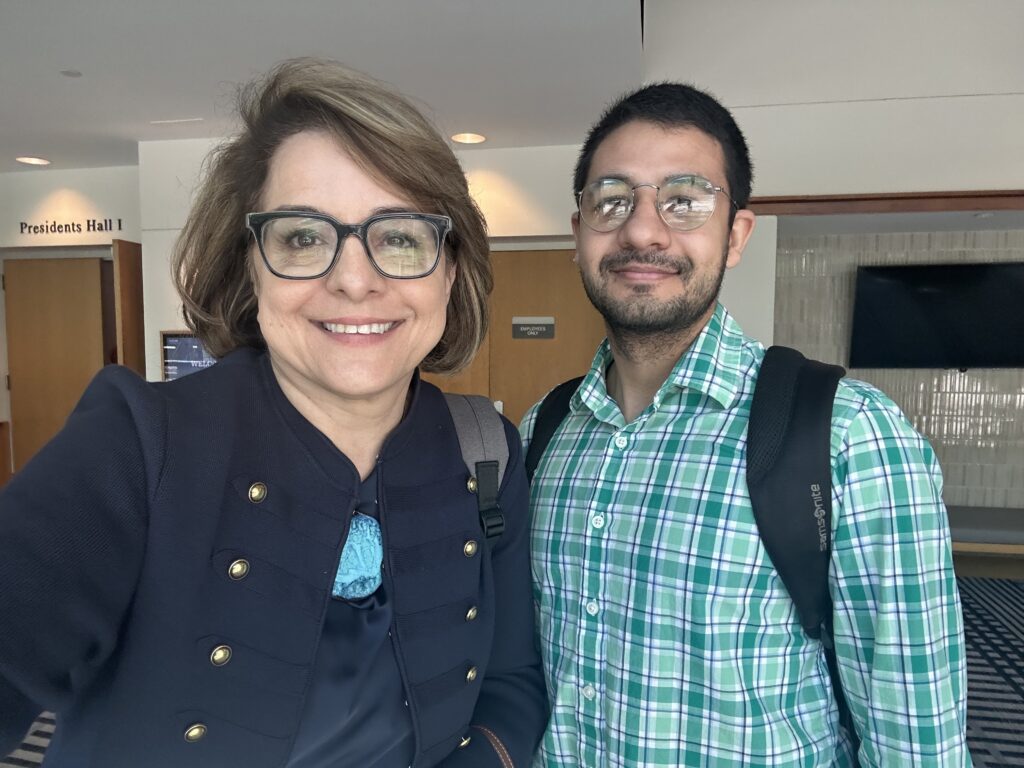
Davar Ardalan, Director of AI Integration and co-Founder of bAI labs, is a featured panelist at The Chamber of Business & Industry of Centre County (CBICC) AI Summit. The Summit brings together small businesses, nonprofits, and entrepreneurs to explore how Artificial Intelligence is reshaping the way organizations operate, innovate, and grow.
Below is an overview of Davar’s talking points. Curious to learn more? Download our Applied AI Guide to understand how to introduce AI safely, train your team, and test real-world use cases before full adoption.
AI Is Not Replacing Expertise — It’s Capturing and Scaling It
BAI Group has spent 40 years building expertise across civil engineering, environmental compliance, landfill operations, renewable energy, and infrastructure. The question we’re asking isn’t how AI replaces people. It’s how AI helps preserve and scale the knowledge of experienced professionals before it walks out the door.
- Our work on engineering knowledge systems, such as John Smith GPT, demonstrates that AI can serve as a “knowledge keeper,” capturing decades of field experience and making it available to younger staff and future generations
- Every industry faces workforce transitions
- AI gives businesses a way to preserve institutional memory and reduce costly mistakes
Key takeaway: Your most valuable business asset may not be your equipment or software — it’s the knowledge inside your people.
The Future of AI Is Applied AI, Not Generic AI
At bAI Labs, we’re testing AI against real-world infrastructure problems. For example:
- Solar-powered methane monitoring at landfills, where operators can actually talk to the data
- GeoAI research using Earth observation models like OlmoEarth from the Allen Institute for AI to detect environmental changes earlier
- AI systems that harmonize information from multiple monitoring locations into a single operational picture
- Field intelligence systems that bring engineering knowledge directly to workers in the field
Key takeaway: Once you use AI tools and understand the efficiencies they can bring, the next biggest opportunity is applying AI to your unique operational challenges.
Businesses Should Become AI Testbeds, Not AI Spectators
One of the biggest mistakes organizations make is waiting for the perfect AI solution. The organizations that will win are the ones that learn by testing. At bAI Labs, we believe:
- Test with your data
- Test with your workforce
- Test against your actual workflows
As we’ve learned in engineering, no model is proven until it works in the field. AI is no different. The testing has to happen where the work happens. This is why we’re actively testing, conducting pilots, and validating tools in operational environments rather than relying on vendor demonstrations.
Key takeaway: Don’t ask, “What can AI do?” Ask, “What problem would I like AI to help me solve next month?”
Responsible AI Creates Competitive Advantage
Trust will become one of the most important business differentiators of the AI era. At BAI, we’ve built a five-part AI Governance Framework centered on:
- Transparency
- Privacy and security
- Human oversight
- Efficiency
- Continuous learning
The businesses that succeed with AI won’t necessarily be the ones using the most AI. They will be the ones who can demonstrate:
- Why the system was used
- How decisions were made
- What data was used
- Where humans remain accountable
Key takeaway: Responsible AI isn’t a compliance burden. It’s a competitive advantage.
Closing Call to Action
Forty years ago, BAI Group helped organizations navigate environmental regulations, waste management, and infrastructure challenges. Today, through bAI Labs, we’re helping organizations navigate a different kind of infrastructure challenge: artificial intelligence.
If you’re interested in testing, validating, or prototyping AI for your business, let’s talk; we can share details about our AI Foundations workshops. These hands-on, creative, and practical workshops help participants leave with six AI learning cards they create themselves that cover pattern recognition, prediction, machine learning, training data, prompting, hallucinations, and verification. The goal isn’t just to learn AI for two hours — it’s to take the conversation back to your workplace and continue building understanding long after the workshop ends.