By Davar Ardalan
After spending several days at London Tech Week and The AI Summit London 2026, I expected to come home thinking about artificial intelligence. Instead, I came home thinking about trust. That may sound surprising.
The headlines coming out of London were filled with discussions about autonomous agents, robotics, foundation models, and the rapid pace of technological change. Yet one of the most thought-provoking sessions I attended had very little to do with the technology itself.
It focused on what happens after AI begins working.
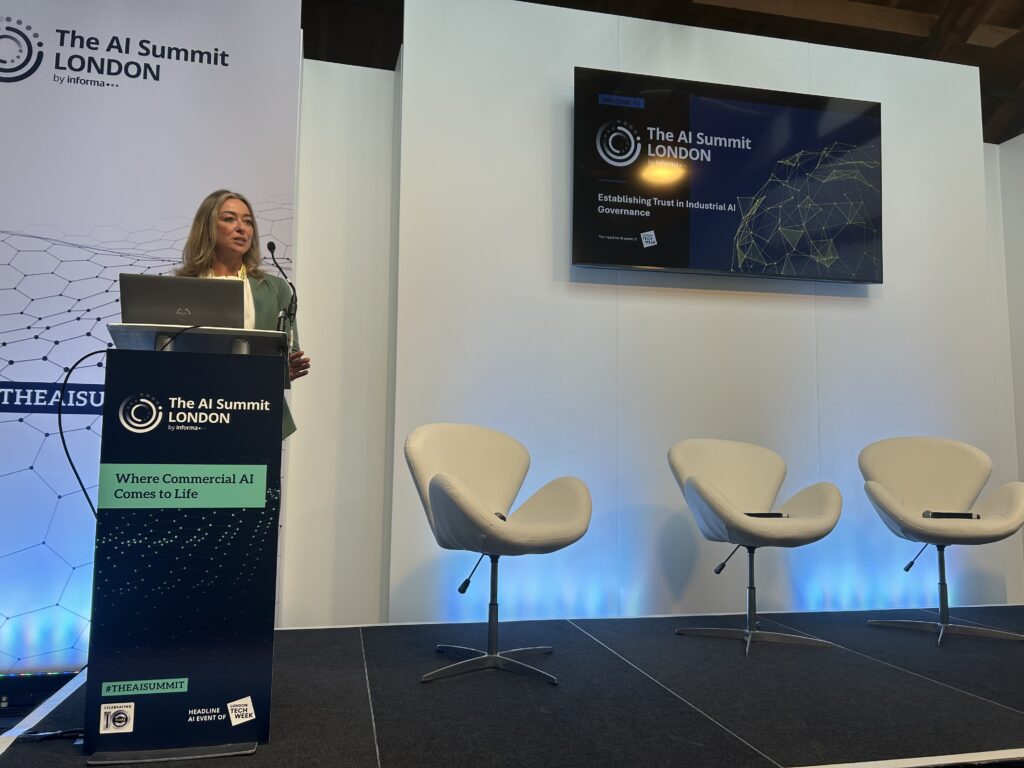
The session was led by Rebecca Gallagher of Weir, a global company that has spent years moving AI from experimentation into real business operations. Today, Weir uses AI-driven technologies for predictive maintenance, computer vision monitoring, intelligent planning, and productivity tools such as Microsoft Copilot. Like many organizations, they are now managing growing portfolios of AI systems embedded throughout their business.
What struck me was that the conversation was not about whether AI works. The conversation was about how to scale it responsibly.
Across the United States, public discussions about AI often center on concerns around transparency, privacy, accountability, synthetic content, data usage, and human oversight. Whether people are interacting with chatbots, sharing information online, or encountering AI-generated content, they increasingly want answers to a few basic questions:
- Who is accountable?
- How is my information being used?
- Am I interacting with a human or a machine?
- Who is responsible when something goes wrong?
These are not anti-technology questions. They are trust questions. One statement from Gallagher’s presentation captured this perfectly:
“You can’t govern what you can’t see.”
The more I thought about it, the more I realized this may be one of the most practical lessons available to organizations of any size. Many businesses already have more AI in use than they realize.
- An employee uses ChatGPT to draft a report.
- A marketing team experiments with AI-generated content.
- A software platform quietly introduces new AI features.
- A manager relies on an AI assistant to analyze data or summarize meetings.
None of these activities are necessarily problematic. But together they create a challenge.
How do leaders maintain visibility into technologies that are being adopted faster than traditional policies can keep up? At bAI Labs, we often encourage organizations to start with something simple: an AI Catalogue. Think of it as a living inventory of AI systems, tools, pilots, and use cases across an organization.
- What is the tool?
- Who owns it?
- What data does it use?
- What business problem is it solving?
- Where does human oversight occur?
In many cases, this can begin with a spreadsheet. Over time, organizations can develop AI Transparency Cards that document how systems operate, how performance is measured, what safeguards are in place, and who remains accountable.
The goal is internal visibility. Because trust is difficult to build around systems nobody understands.
One of Gallagher’s slides outlined the risks organizations worry about most as AI adoption grows. They included cybersecurity threats, data leaks, privacy concerns, bias, intellectual property exposure, compliance obligations, and reputational damage.
But what caught my attention was where those risks ultimately led.
Loss of customers. Loss of trust. Loss of talent. Lost revenue. The lesson was simple. The biggest AI risks are rarely technology risks alone. They are business risks. And increasingly, they are leadership risks.
Another aspect of the presentation that resonated with me was the idea that governance should not be isolated inside a legal department or IT team. One slide showed governance spanning security, architecture, legal, compliance, procurement, business leaders, product owners, risk managers, and operational teams. In other words, governance is not a silo. It is a shared responsibility.
That observation feels especially relevant today. As public concerns about AI continue to grow, organizations cannot rely on disclosure statements alone to build trust. Trust comes from demonstrating that someone remains accountable, that systems are monitored, and that decisions are made transparently.
Throughout the summit, another theme surfaced repeatedly:
Human in the Loop is essential.
Not as a temporary safeguard.
As a design principle.
Artificial intelligence can identify patterns, summarize information, and generate recommendations.
But it cannot assume responsibility.
It cannot exercise judgment in the same way experienced professionals can.
It cannot replace accountability.
Increasingly, I heard that people more concerned about whether a qualified human remains responsible. At BAI Group and bAI Labs, we often summarize this principle in a simple phrase: AI assists. Humans decide. That idea applies equally to engineering, infrastructure, education, public service, healthcare, and business.
One of the most valuable lessons I brought home from London concerns the role of policymakers and regulators. Too often, innovation and regulation are presented as opposing forces. In reality, the strongest innovation ecosystems require both. Businesses have a responsibility to be transparent, protect privacy, invest in AI literacy, and maintain human accountability.
But regulators also have a role to play. If we want innovation to thrive, government cannot simply act as a referee waiting on the sidelines for something to go wrong. Government can help create the conditions for responsible innovation.
One promising approach is the use of innovation sandboxes and pilot environments where businesses, universities, municipalities, utilities, and regulators can learn together before technologies are deployed at scale.
Imagine local governments testing AI-assisted permitting. Utilities evaluating predictive maintenance systems. Water authorities exploring anomaly detection tools. Small businesses piloting customer service applications. The goal is evidence.
When organizations can experiment responsibly, policymakers gain real-world insights, businesses gain confidence, and communities benefit from better outcomes. That creates a healthier feedback loop than relying solely on assumptions about what AI might do in the future.
Another lesson from London was the importance of AI literacy. One of Gallagher’s slides outlined a roadmap focused on assessing needs, designing training programs, communicating value, customizing education, and continuously adapting as technology evolves. That may sound less exciting than discussing the latest AI model. But it may be far more important.
Most compliance failures will not occur because people are acting irresponsibly. They will occur because people do not fully understand the tools they are using. Technology alone rarely transforms organizations. People do.
Perhaps my favorite moment of the week came when Gallagher shared a phrase she had heard from another leader:
“AI is no longer a game of chess. It’s a game of squash.”
The room laughed because everyone immediately understood.
The technology is moving quickly. The environment keeps changing. The challenge is building organizations that can adapt while maintaining trust. That, more than anything else, may be the lesson I brought home from London. The future of AI will not be determined solely by the quality of our algorithms.
It will be shaped by the quality of our institutions, our leadership, our workforce, and our willingness to create systems that are both innovative and accountable.