A recent demo from Google DeepMind offers an early glimpse into how artificial intelligence might begin handling complex infrastructure problems, not just analyzing them, but assembling them step by step.
In the video, engineer Michael Chang walks through a small, experimental web app powered by Google’s Gemini 3.1 Pro. The concept is simple: generate a believable city from scratch.
The execution is what makes it interesting — even at this early stage.
The model starts by generating terrain, identifying water, elevation, and buildable areas. It then places hubs where people might logically settle, simulates movement between them, and uses those paths to form road networks. The final step produces a satellite-style image of the result.
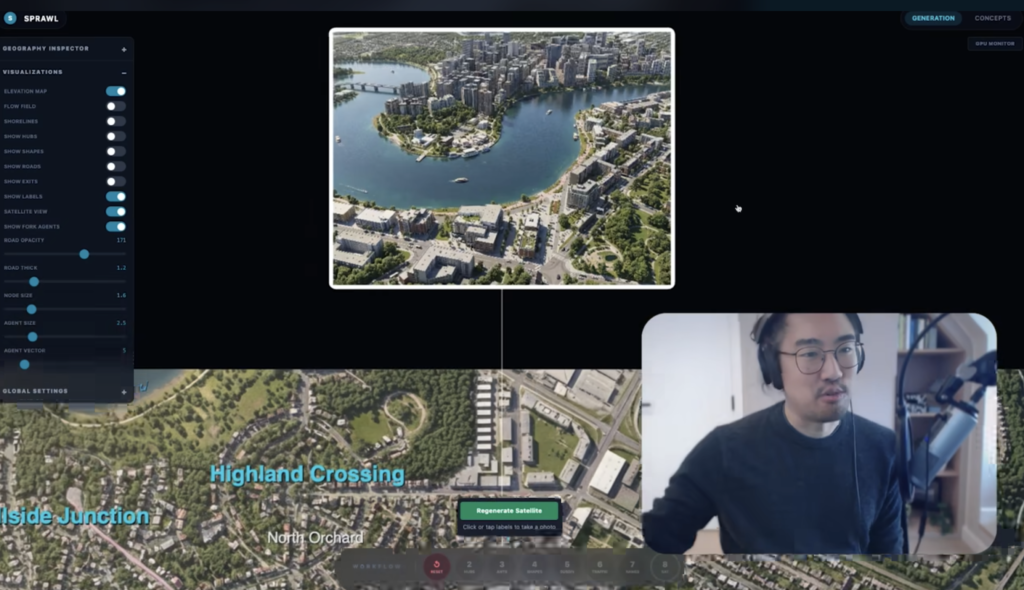
As Chang explains, “Every step along the way … [the model] creates programs to solve individual problems, then assembles them into the larger picture.”
What stands out is the structure of the workflow. Instead of producing a single output, the system breaks the problem into parts, terrain, infrastructure, and movement, and stitches them together.
It feels less like a finished tool and more like watching a very early-stage designer think.
If you’ve ever watched an architect work through a concept — starting with the site, sketching constraints, placing forms, then imagining how people move through space — the pattern is familiar. At BAI Group, we approach projects the same way. Whether it’s landfill design, solar siting, or environmental permitting, nothing is solved all at once. It’s iterative. Layered. Grounded in constraints.
This demo shows an AI attempting a version of that process — not designing in a true engineering sense, but sequencing decisions in a way that starts to resemble it.
Google’s Addy Osmani described this as combining spatial reasoning, simulation, and visualization into a single workflow. That’s directionally important — but it’s still a long way from real-world application. This is a controlled demo, not a tool that accounts for permitting, constructability, or long-term performance.
Some reactions captured that gap well. One widely shared comment noted, “A believable city is not necessarily a livable city.”
It’s a reminder that real infrastructure is shaped by far more than geometry — including regulation, environmental systems, budgets, and human behavior over time.
At BAI Group, this is exactly where our work lives — in the transition from concept to reality. We deal with sites that settle, systems that age, permits that evolve, and communities that depend on outcomes over decades, not just visuals on a screen.
Davar Ardalan, BAI’s Director of AI & Strategic Initiatives, notes: “What’s interesting here is the structure, breaking a complex system into parts and rebuilding it. That’s familiar territory in engineering. The gap, right now, is between demonstration and real-world application.”
Another way to think about it: this is closer to a conceptual sketch than a stamped set of plans. It’s useful for exploring ideas, but it’s not something you could build from.
And that’s where some healthy skepticism is warranted.
Early demos like this are compelling, but they simplify the hardest parts of engineering, uncertainty, regulation, liability, and long-term performance. In our world, it’s not enough for something to look right or even simulate well. It has to hold up in the field, under constraints, over time.
This is still very early. The direction is interesting. But for now, it’s a signal, not a solution.
This story was prepared with AI assistance under human review.