Sel Edor, General Manager of Renewables
The Cornell School District’s transition to becoming the first 100% solar-powered school district in Allegheny County was one of the most meaningful moments of our year. Most of that credit belongs to a small, determined school community that approached a necessary infrastructure upgrade with clarity, patience, and long-term thinking.
Cornell is a single-building district serving 575 students west of Pittsburgh. When school officials recognized that their roof was nearing the end of its service life, they made a thoughtful decision to explore whether the roof replacement could also become an opportunity to address rising energy costs. That simple question opened the door to a project that is already strengthening their financial stability for decades to come.
Our early conversations were grounded in practicality: how to pair a roof replacement, an event that happens only every few decades, with a clean energy solution that would ease future budget pressures. Cornell’s openness and steady engagement made it possible to plan both pieces together, rather than in isolation.
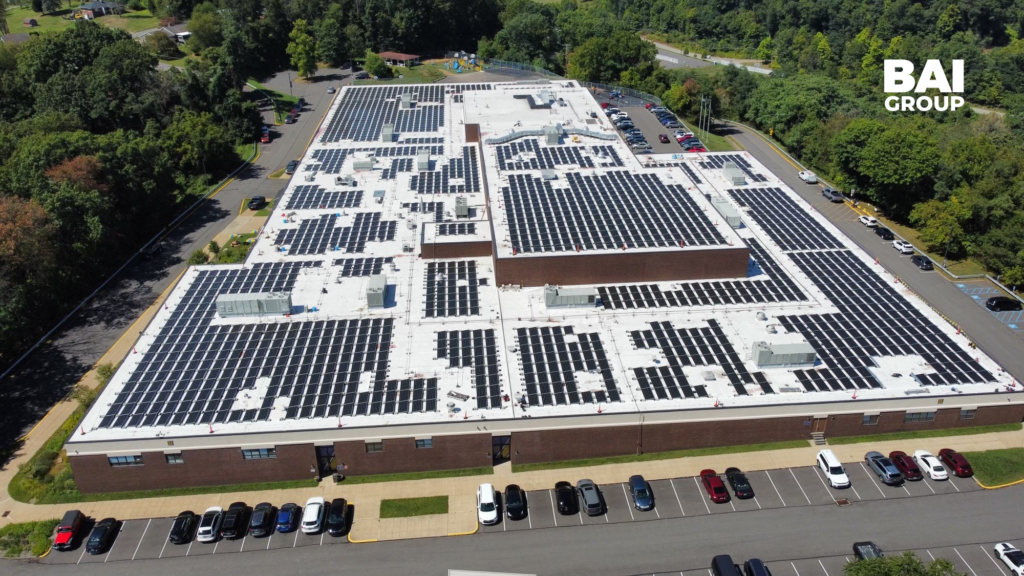
The result was a coordinated effort: a new 30-year warranty TREMCO roof installed by Pennsylvania Roofing Systems, alongside a 1,300-kilowatt (kWdc) rooftop solar array designed to operate reliably for the life of the roof. Integrating both systems required careful timing and collaboration across multiple teams, and Cornell approached each step with a steady hand and a clear focus on what would best serve their students.
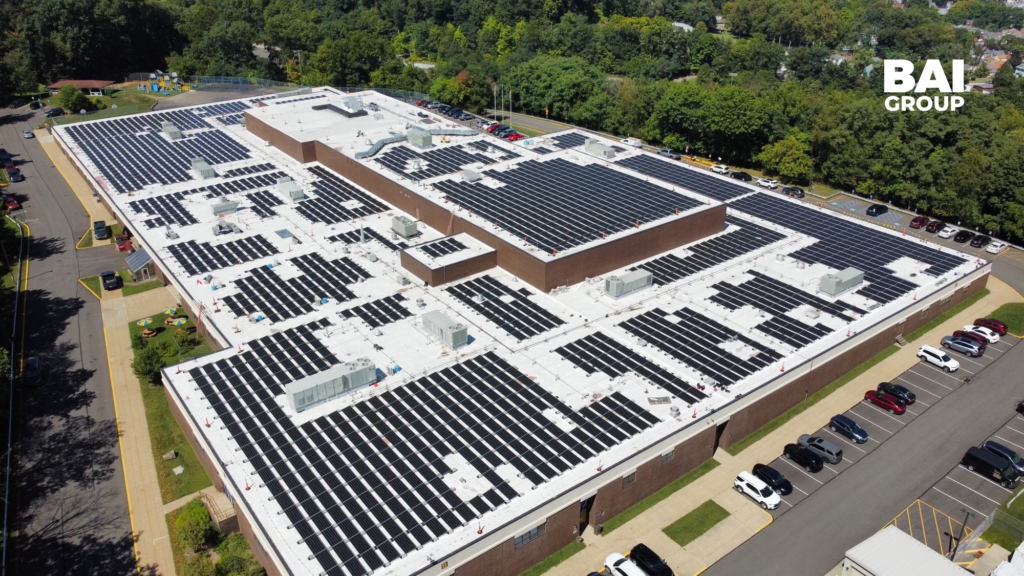
A key part of making this project viable was the financial structure. Through a Power Purchase Agreement (PPA), Cornell did not need to spend money up front. Instead, BAI leases the rooftop, builds and operates the system, and provides electricity at a stable rate lower than projected utility costs. Over the next 30 years, the district is expected to save approximately $2.5 million — savings that can support teaching and learning rather than unpredictable energy bills.
For me, this project speaks to the core of my work leading BAI’s renewable initiatives. My role involves bringing together strategy, engineering, financing, and community collaboration. But progress is never made alone. Cornell’s leaders asked thoughtful questions, weighed their options carefully, and carried a quiet determination to make the most of a rare infrastructure moment. We were also fortunate to have a great collaborative relationship with TREMCO, a national leader in quality roofing materials, which supplied the roofing materials and technical support throughout the project. Another key team member was Pennsylvania Roofing Systems, a premier roofing and mechanical solar installation company that installed both the roof and the solar racking and modules. Collectively, their approach made this project what it is.
It has also been encouraging to see Cornell recognized publicly for their leadership, including acknowledgment from the Pennsylvania Solar Center. But the real significance lies in what this means for their students. Every day, those students walk into a building powered entirely by sunlight — a visible reminder of a decision rooted in responsibility and forward thinking.
Cornell’s example shows that meaningful progress doesn’t require size or resources—just timing, intention, and a willingness to explore new possibilities. Many other schools and communities face similar circumstances, and Cornell’s story offers a practical path forward.
To everyone at Cornell School District, thank you for your trust and collaboration. It has been a privilege to support your goals.
And to organizations preparing for their own energy decisions in 2026, we’re here to help you navigate shifting federal requirements, evaluate project timing, and understand which options align best with your community’s needs. We look forward to supporting more schools and municipalities as they take their next steps toward long-term energy resilience.
FACTS TO KNOW: 2026 FEDERAL TAX CREDIT DEADLINES
Federal rules now require wind and solar projects to show meaningful physical construction before July 5, 2026, to remain eligible for the Section 45Y and Section 48E clean electricity tax credits.
These credits will no longer apply to projects that begin construction after that date.
Here’s what project owners should know:
- “Begin construction” now means real physical work, not planning or paperwork.
- Work must continue without major interruption. Projects have a four-year safe harbor to be completed and placed in service.
- Delays do not extend the clock, so documentation and steady progress matter.
- The One Big Beautiful Bill Act (OBBBA) has rolled back several clean energy incentives, including ending 45Y/48E for projects starting after July 4, 2026.
- The IRS is now requiring stricter proof of progress to prevent “artificial acceleration” of eligibility.
What this means:
Developers, schools, municipalities, and investors should assess current timelines and confirm that their projects can meet the July 2026 threshold.
BAI is here to help.
Our team can guide you through these federal requirements, evaluate project readiness, and help ensure your solar project stays on track and fully incentive-eligible heading into 2026.
Editorial note: This blog was prepared with AI assistance under human review and fact-checking.