Sometimes the best way to understand an environmental project is to watch it change.
At the Berks Landfill Superfund Site in Spring Township, Berks County, Pennsylvania, BAI Group is conducting a pilot study, with support from the U.S. Environmental Protection Agency (EPA) and Pennsylvania Department of Environmental Protection (PADEP), to evaluate whether wetland treatment could provide a passive, long-term treatment approach for water collected at the site.
The ponds receive mostly stormwater, along with landfill leachate, and the pilot is examining how a constructed wetland may help remove targeted constituents from that water. The study is still underway. But after approximately one and a half growing seasons, the photographs offer an interesting look at how the pilot has progressed, from construction and small wetland plantings to a more established wetland community.
A site with a long environmental history
The Berks Landfill property was historically used as an iron ore mine and later operated as a municipal landfill from the 1950s until operations ended in 1986. EPA added the site to the Superfund National Priorities List in 1989 following investigations of contamination at the site.
EPA selected a remedy in 1997 that included repairing the landfill cap and leachate collection system and conducting long-term environmental monitoring. As part of the cleanup, three leachate collection ponds were reshaped and relined. The ponds collect leachate before it is pumped to a local wastewater treatment plant. EPA deleted the site from the National Priorities List in 2008, but monitoring and maintenance continue.
BAI performs post-remedial maintenance and monitoring activities at the site to support continued implementation of EPA’s selected remedy.
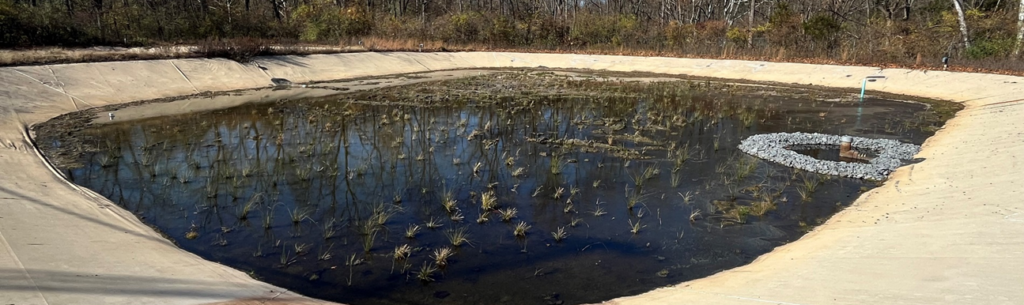
The first photograph captures the pilot shortly after planting.
At this stage, the plants are almost easy to miss. Small wetland plugs emerge from shallow water across the pond. This was very much the beginning of the experiment.
The middle pond in the site’s series of three leachate treatment ponds was selected for conversion to a wetland as the initial phase of the pilot study. The immediate question was straightforward but important: Could the selected plants survive and establish themselves under actual leachate conditions?
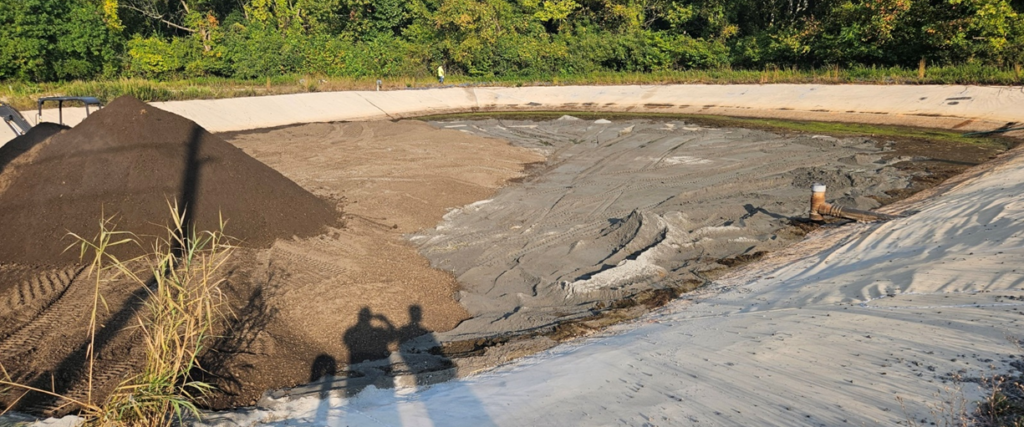
The second photograph takes us back a little further, to construction.
Rather than creating a perfectly level pond bottom, soils were placed to produce an uneven surface more representative of natural wetland conditions. That creates different moisture conditions across the wetland, from barely saturated areas to areas that remain continuously inundated during the growing season. Care was also taken to minimize compaction of the growth media.
That variation provides different conditions in which a diverse plant community can become established.
The wetland was planted with herbaceous plugs and bare-root material from emergent wetland species and supplemented with a wet-meadow seed mixture. The species were selected both for their potential to collectively treat contaminants in the water column in similar facilities and for their ability to create a diverse native wetland community.
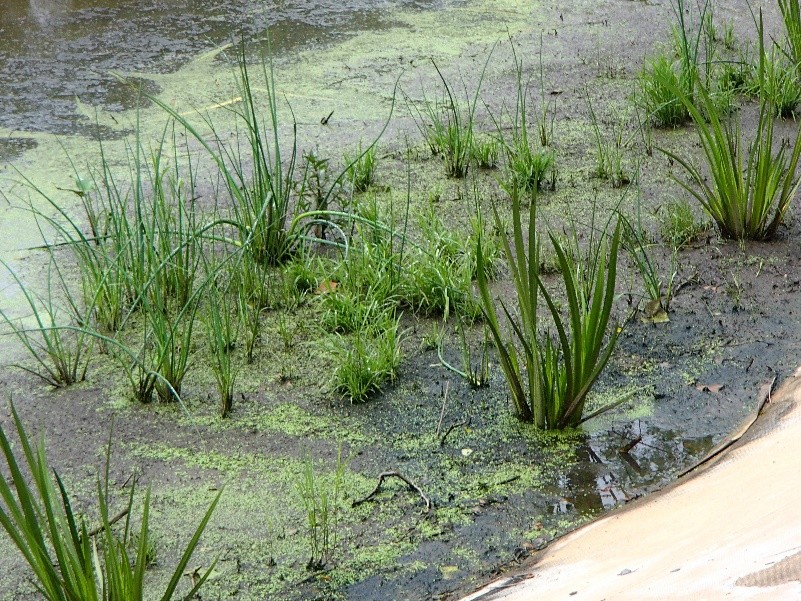
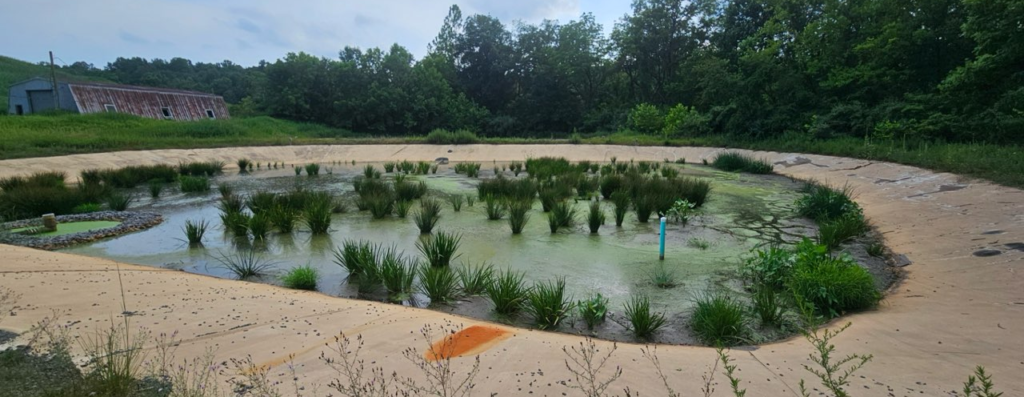
Now compare those first two photographs with Images 3 and 4.
The tiny individual plants have grown into much more visible clusters of wetland vegetation. After approximately one and a half growing seasons, all of the planted species remain present and have become well established. Most are showing growth, some significant new growth, and several additional species have recruited naturally into the wetland. But it is not yet evidence that the wetland is successfully treating the leachate. That comes next.
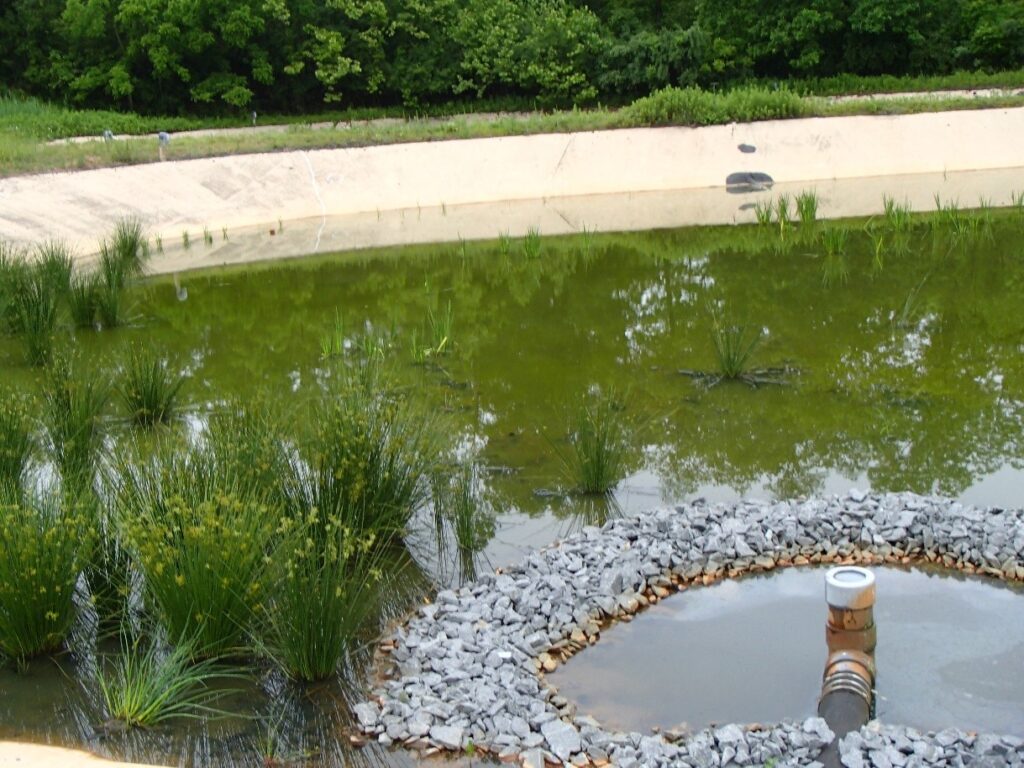
The fifth photograph shows just how different the pond looks as vegetation becomes established.
And the plants aren’t the only new arrivals. BAI’s environmental specialists have observed a little green heron, red-winged blackbird, barn swallows, a great blue heron, white-tailed deer and frogs using the wetland. There has also been evidence of Canada geese and muskrat. During one site visit, a pair of adult mallards that had established a nest nearby were observed in the pond with their five ducklings.
Those observations don’t tell us how well the treatment process is working. They do, however, provide another visible measure of how much the pond environment has changed since those first small plants went into the ground.
The most important results are still to come
The photographs tell part of the story: construction, planting, and the gradual establishment of the wetland vegetation. Wildlife already present around the site also appears to be making use of the newly planted area, adding another dimension to how the landscape is evolving. But the most important results will come from the data.
The collection ponds receive water influenced substantially by stormwater, along with leachate from the landfill. Future sampling and laboratory analysis will help determine how effectively the pilot wetland removes targeted constituents from the water as it moves through the system.
If the pilot study is deemed successful, BAI will investigate appropriate next steps with EPA. In the meantime, collected leachate continues to be pumped to the local wastewater treatment plant for treatment.
That distinction matters. Environmental engineering innovation is not about assuming that a promising idea works. It is about testing an approach under real-world conditions, observing what happens, collecting and analyzing the data, and deciding what the evidence supports.
At Berks Landfill, the plants have taken root and the wetland is becoming established. Now comes the science.